
Words Worth Watching
by Lu Rose Cunningham

This May, independent Leeds-based imprint Wild Pansy Press celebrated its 30th year with the exhibition Words Worth Watching in the Project Space at the University of Leeds. With working ties to the press through its latest initiative The Writers’ Room, Lu Rose Cunningham explores its history and the role of such independent projects in encouraging connectivity, circular economies and shared learning. Lu spoke to Wild Pansy Press founders Chris Taylor and Simon Lewandowski, poet Tom Branfoot of More Song, writer and editor Nick Thurston, and Joanna Jowett of fellow Leeds-based press COPY.
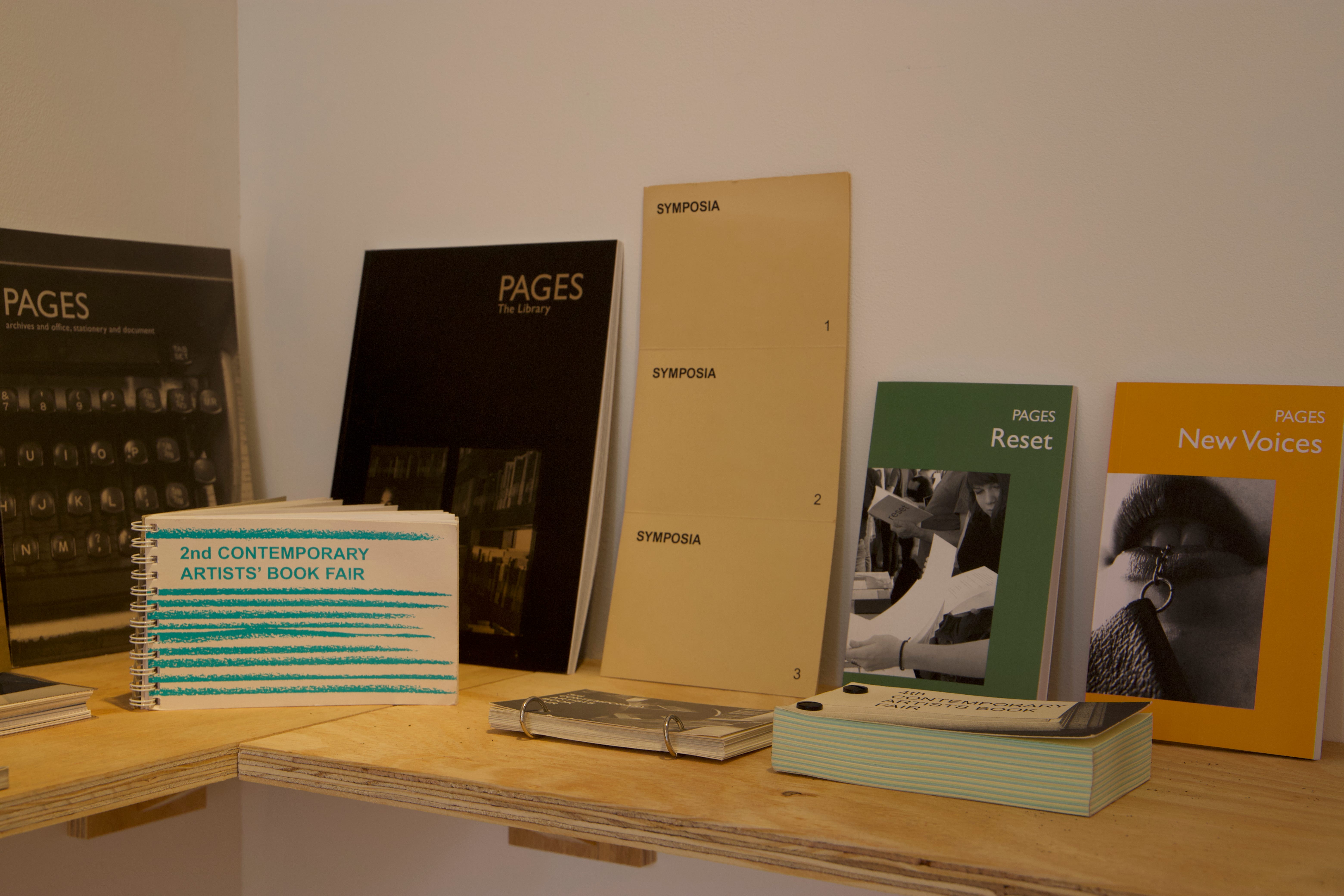
The Wild Pansy Press (WPP) is an independent publishing press and collective art practice established in 1995, which has built up a considerable catalogue of books and projects, often linking a publication to an exhibition in ways which extend and confound the usual notions of a catalogue. WPP actively develops and supports collaborations, as in behind land: poems and paintings (2015), which brought together artist Judith Tucker and poet Harriet Tarlo to explore images, landscape and eco-poetry. WPP’s name comes from the title of Levi Strauss’ 1962 book La pensée sauvage, meaning ‘savage’ or untamed thoughts, but which can also be literally translated as ‘wild pansy’. In that double-play, I read the implication that savage thoughts might lead to radical thinking, to wild and freeing approaches to making.
I first came across the press a decade ago when I joined University of Leeds’ School of Fine Art, History of Art and Cultural Studies, where press editors Chris and Simon would become my tutors and subsequently long-term friends and colleagues. Today, Simon and I run The Writers’ Room (TWR), an offshoot of WPP in London, both a residency programme and a site for those working at the intersection of fine art and literature. We host residents who are developing art writing, auto-fiction, sound art, broadcasting and spoken word projects. The space is a working studio that we invite guests to reimagine and repurpose. So far, it has been used for publication launches, performances, screenings, symposia and quiet writing. It is, I hope, a place to reposition reading and writing as situated and embodied engagements.
Having continued our relationship with Leeds, the School of Fine Art suggested we celebrate the press in its anniversary year and bring TWR too. Chris secured the space and brought with him the extensive WPP archive; Simon and I curated a series of contributions by artists and writers who had done residencies with us in London, each with links to cities across the North, including George Storm Fletcher, Joanna Jowett, Elaine Fisher, Emily Fielding and Lily Petch. Words Worth Watching was a week-long exhibition and events series, with workshops led by Emily and Joanna, the latter joining Chris Taylor for a talk on the final day. Live readings animated the opening night, with current fine art students presenting work alongside the exhibitors.
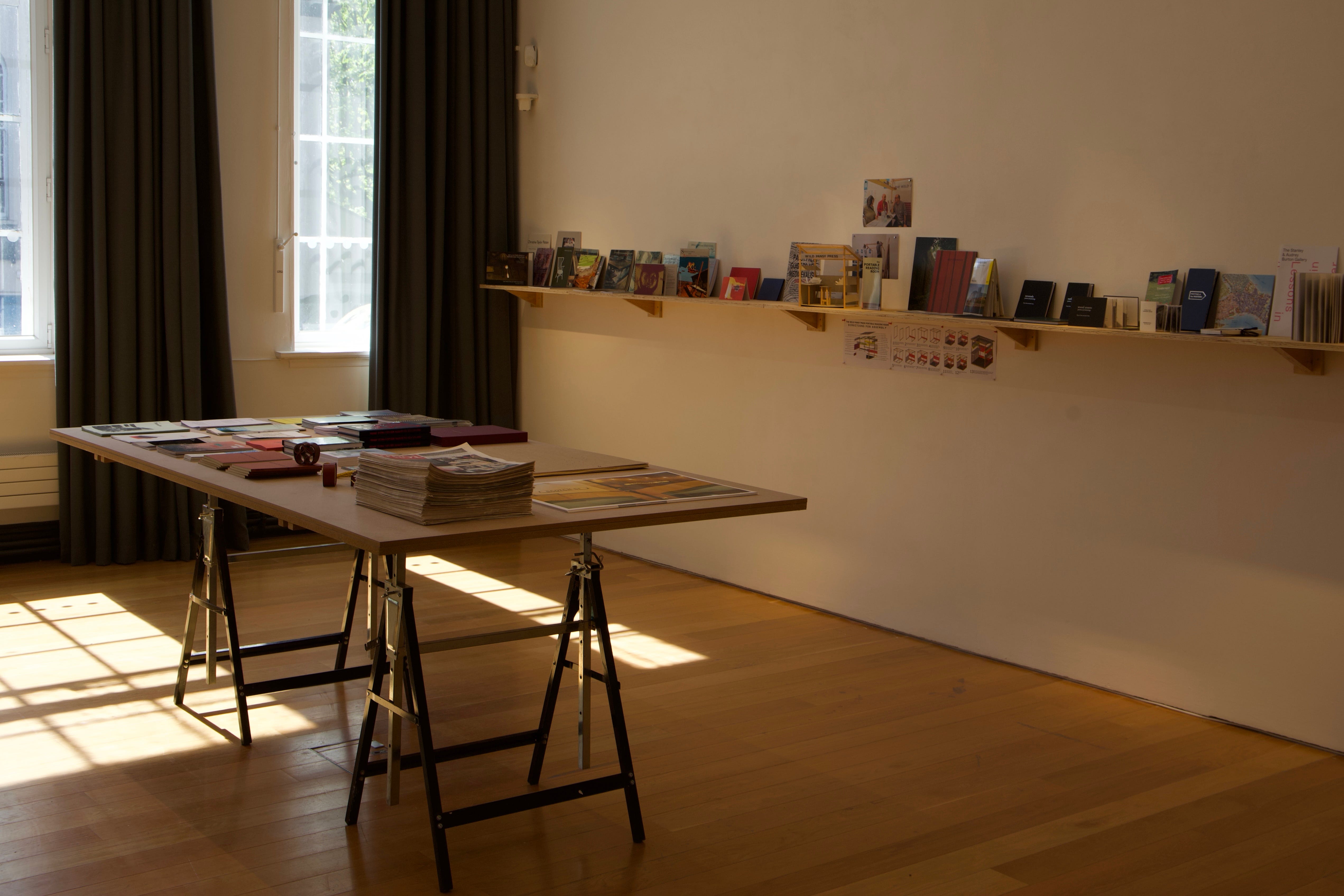
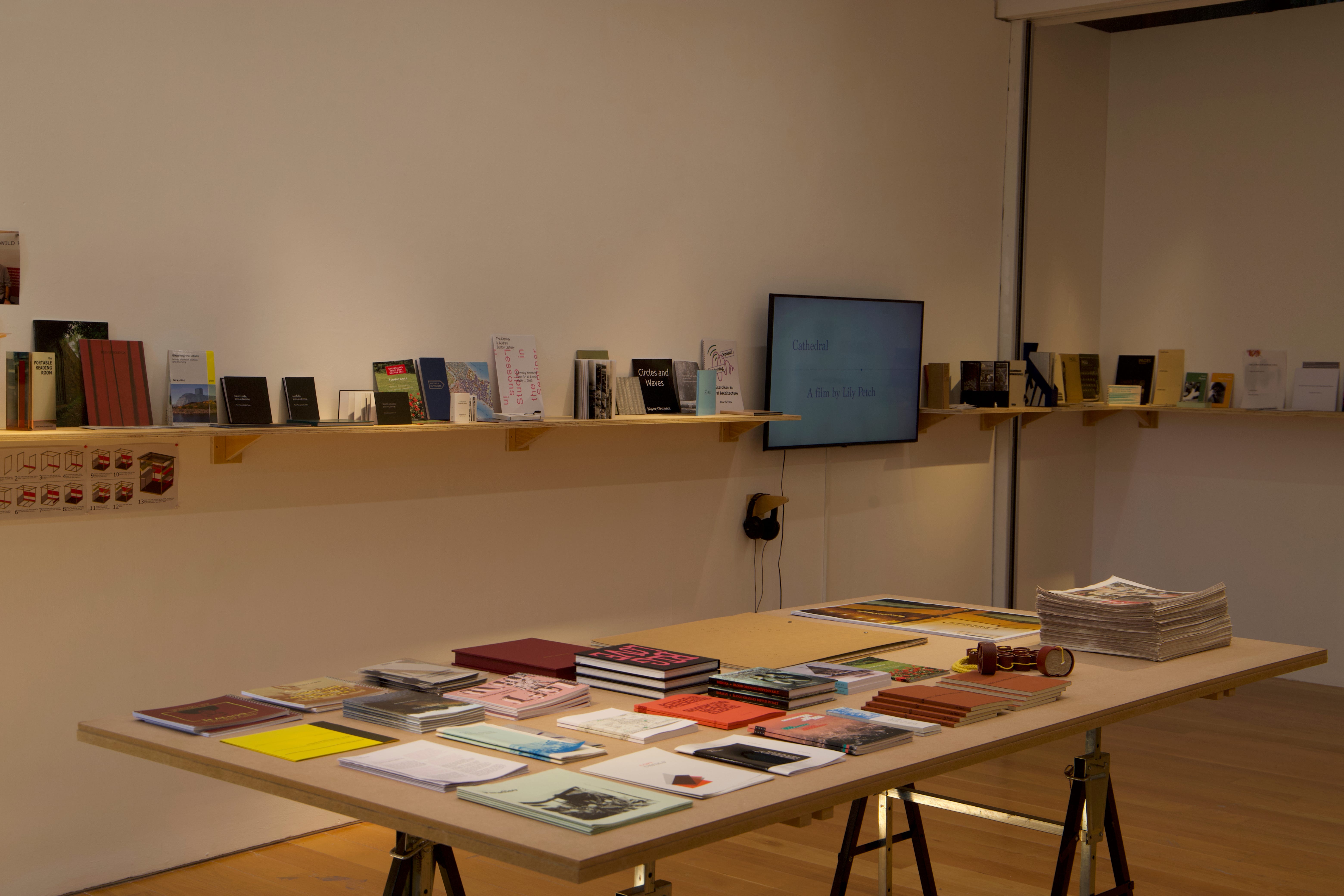
I am writing this while sitting in the exhibition space. Shelves skirt the edges, running in a continuous horizontal line around the room. Books line the shelves, inviting the reader to circulate, navigating a multiplicity of perspectives and knowledges. Where one person’s knowledge and practice ends, someone else’s continues, cover to cover, edge to edge. The shelves float on the wall like the margins on a sheet of paper. We want these books to be picked up and interacted with. Two monitors share the films of Lily and Joanna, punctuating the continuous line of the shelves which also acts as a timeline. In the middle is our workbench and the floorspace for performance, discussion and sociable reading. This setup puts the centre and the margin in a dialectical co-becoming, while emphasising the margins of the room as ‘zones of unpredictability’.1 Centre and margin coexist relationally. This idea is at the core of WPP and TWR, as well as many of those who have interacted with, or been elevated by, WPP over time.
In the centre of the room there are clusters of seating for those who want to read or watch the films on display. An off-set table doubles up as a workshop bench and reading desk.
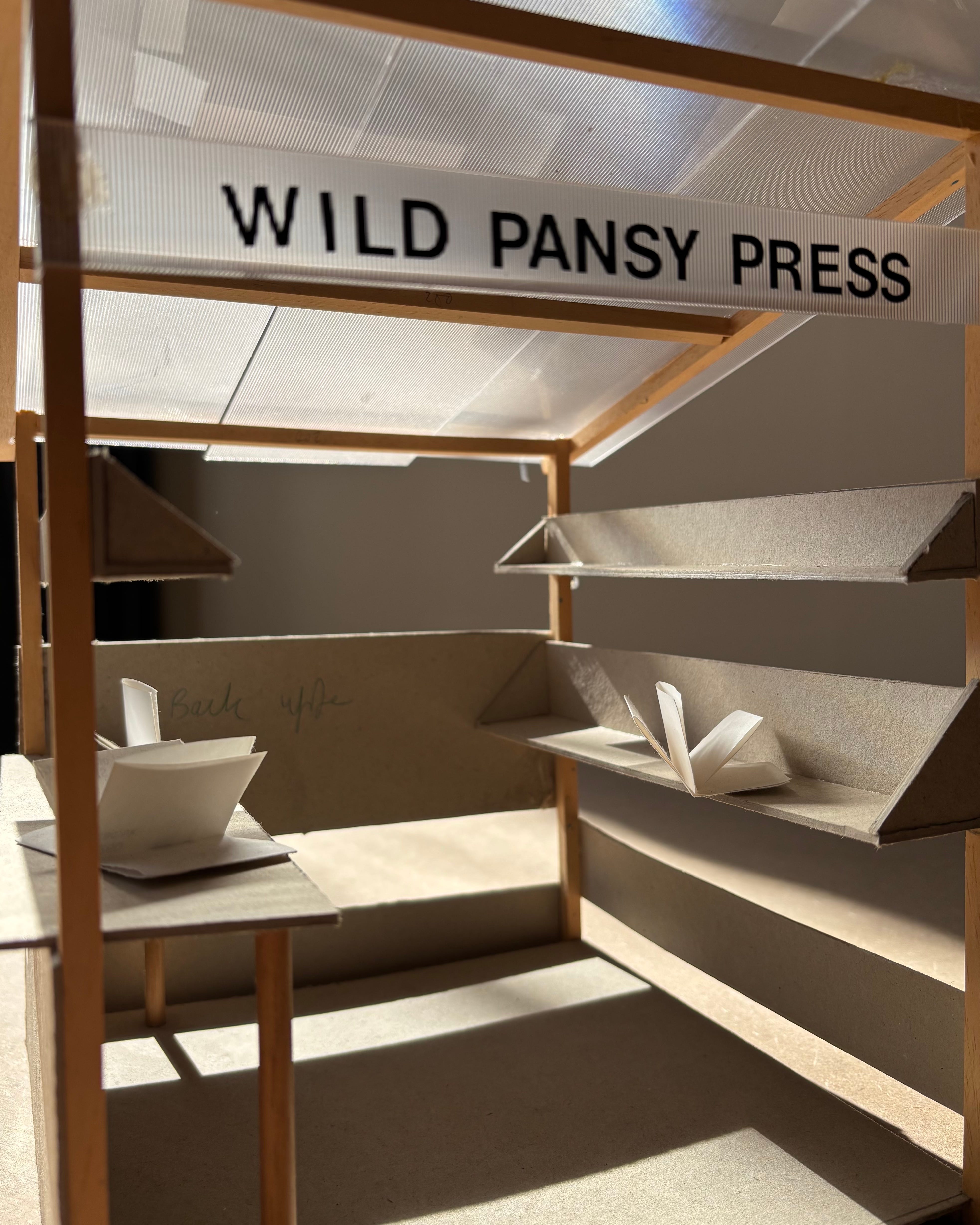
It is at this table that I spoke to various contemporaries from Yorkshire’s artist book ecology. Discussing the press and its previous projects, Simon shared how TWR and Words Worth Watching was largely inspired by WPP’s ‘Portable Reading Room’, which was designed and built in 2011 to act as a mobile project space, gallery and bookshop:
‘It was a flat-pack, easy-assembly, enclosed structure incorporating seating, a layout area where books could be displayed and examined, and, on the exterior surfaces, an area for displaying artwork, a notice board and signage. As well as being a site for activities, the Portable Reading Room was a social sculpture in its own right, centred on the activity of reading and the book as an expressive medium. Readers were encouraged to interact with one another in an unfamiliar but welcoming space and, in a sense, put themselves ‘into’ the imprint. It could be incorporated into an exhibition, set up in public spaces such as museums - namely in 2012, when it was in residence at Leeds Art Gallery - universities, theatre foyers and festivals. It complemented a broad range of events such as exhibitions, art fairs, conferences, school and college curricula.
The Portable Reading Room visited a range of venues to publicise and disseminate our imprint. In return, it offered a space for artists working with WPP and for local groups to devise and run their own activities based around ideas of reading, writing, publication and the integration of these into visual art. These collaborative activities offered a platform to a network of practitioners enabling audiences to become active participants. The portability of the project meant it could be shown in venues of any size, from a village hall to a city gallery, for periods of a day to one month. One of the main aims of this project was to break down boundaries between what are separately seen as “Literature”, “Writing” and “Art” and, by doing so, extend participants’ and their audiences’ understanding of what these forms offer.’
Picking up these notions of active participation and portability, I next spent time with friend and fellow writer Tom Branfoot. Tom is a prolific poet and founder of the independent press More Song, which hosts readings across cities in the North, including Leeds, Bradford, Huddersfield and Manchester.
