
Weaving Operations
by Jenny Steele

Weaver Fever
My weaving obsession began slowly, in the beginning months of the pandemic.
I bought an editioned lithograph by Marion Dorn of one of her ten commissioned illustrations from the re-translated William Beckford Gothic novel, Vathek (1929). This illustration has a pale green and black line drawing in ink and crayon of a woven fence, with rushes in the foreground, that may have provided the material the fence is made of. The simple yet idyllic scene, printed onto cream, details two people relaxing by a river amongst natural materials. The life cycle of the weaving seemed to completely picture a life I wanted to have.
I started collecting postcards of basketry from museums and galleries such as the Ruthin Craft Centre, pinning them up in my studio. I marvelled at the magic of how smaller parts could come together to make a whole. I enjoyed looking and felt satisfaction from the clever construction and repetitive interlocking forms.
Weaving is widely recorded as one of the oldest crafts across all cultures and continents. For over 12,000 years we have instinctually woven plants and fibres together by warp and weft to make clothing and utilitarian objects. In the North of England, we live within a dominant history of industrial weaving, with each town and city having its own proud and often complicated textile story to tell.
Five years ago, throughout a series of challenging personal life changes, I found myself drawn intuitively to weaving. I had worked for several years in print and drawing, responding to in-depth research into interwar architecture, coastal environments and historical textiles. My somewhat private pivot to weaving, from looking outwards to research as a starting point, was a big but welcome shift within an artistic approach that was feeling frustratingly formulaic. I would research and make drawings from stories I found, then make them into sited works using print. To some extent I was disconnected from it personally, apart from picking out motifs.
Looking at weaving gradually turned to making. I was keen to learn. I began with an online passementerie course, which is a technique for making wound and woven trimmings. Over a two-year period, I undertook short courses in basketry, rush weaving and loom weaving. I continued to teach myself from YouTube and books.
Since I have started weaving, I cannot seem to stop. I have heard weavers jokingly call this ‘Weaver Fever’. An addiction to the satisfying connection of warp and weft. The undeniable passion and connection I feel surprises and delights me, but I am curious about why it took me so long to connect with it.
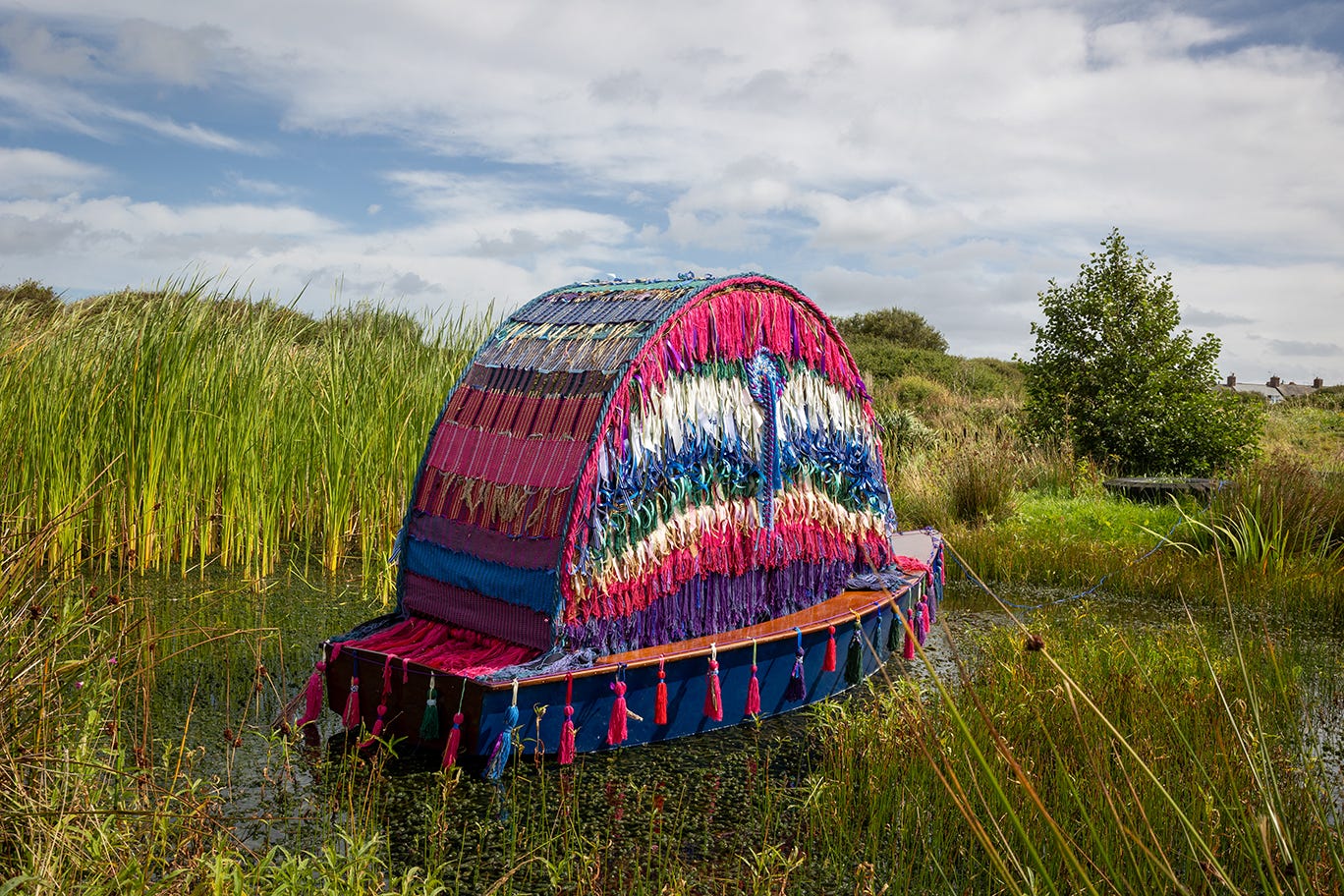
Although the materials and outcomes can differ greatly, I have found there is a regular sequence to the weaving process:
