

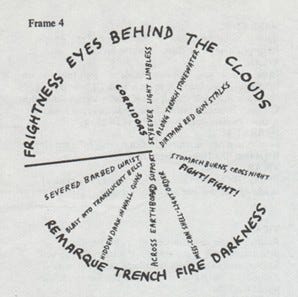
In July 1969, New Worlds magazine published a strange experimental piece by Michael Butterworth with the laborious title ‘Circularisation of Condensed Conventional Straight-Line Word-Image Structures (Radial-Planographic Condensed Word-Image Structures, Rotation About a Point)’. The piece proposed a new technique for expressing narrative that Butterworth called the ‘Circularisation Method’. Conventional prose was reduced to a series of imagistic phrases and then arranged radially on the inside of a circle like the spokes of a bicycle wheel.
Michael Butterworth is best known now as a publisher and editor first of the literary magazine Corridor, which would later become Corridor8, and the co-founder of the avant-garde publisher Savoy Press. Butterworth’s literary career is perhaps less well known, although it is difficult to fully disentangle the two sides of writer and editor in his particular case. The experimental techniques of literary compression that Butterworth developed early in his career would later serve him well as an editor.
Butterworth published the majority of his early fiction in the magazine New Worlds in the late 1960s. The magazine had historically published science fiction, but in 1964 was taken over by fantasy author Michael Moorcock who set about transforming it into an avant-garde literary publication. The magazine in this period was the birthplace of the New Wave in science fiction; a movement that emphasised taboo topics such as sex and mind-altering substances but also encouraged the use of experimental techniques. It was at the forefront of the literary avant-garde in Britain, admired by Angela Carter and Eduardo Paolozzi.
